
· by Michael Blair, Nashville's Insulation
Most attics we open around Nashville do not need the old insulation pulled out. If it is dry, clean and lying flat, new insulation goes on top of it. Removal is slow, dusty work, so it should happen for a reason, and there are only a handful of good ones. This covers those reasons, the one material that should not be disturbed at all, how the old insulation leaves the house, and what has to happen in the empty attic before anything new goes in. The service itself is on our insulation removal page.
Rodents, water, mold and smoke
Mice, rats and squirrels nest in loose fill and batts and leave urine and droppings through it. Insulation that animals have lived in cannot be cleaned where it lies, so it comes out. How it is handled matters. The CDC’s hantavirus risk-reduction recommendations say not to vacuum or sweep rodent urine, droppings or contaminated surfaces until they have been disinfected, to spray them with a disinfectant or chlorine solution until thoroughly soaked, and, for heavy infestations, to wear coveralls, boots, gloves, goggles and respiratory protection. That guidance is written about droppings and surfaces, not insulation specifically, but it is the standard our crews work to in a contaminated attic: wet it down first, then extract it.
Water is the second reason. A roof leak or a bath fan dumping moist air into the attic soaks the insulation below it, and wet insulation packs down and stays damp against the ceiling drywall. The EPA’s mold remediation table for schools and commercial buildings lists water-damaged cellulose and fiberglass insulation as discard and replace, and its mold cleanup guidance for homes says absorbent or porous materials may have to be thrown away if they become moldy. Insulation is about as porous as a building material gets. The leak or the fan gets fixed first, or the new insulation goes the same way.
Smoke is the third. After an attic or house fire, we replace insulation that has taken on smoke rather than adding to it, because loose fill and batts hold the odor and the residue. That is our judgment from the work, not a published rule we can point to.
Vermiculite is left alone until it is tested
Some older Middle Tennessee houses have vermiculite in the attic: a loose, granular fill poured between the joists instead of fiber or batts. The EPA’s page on asbestos-contaminated vermiculite insulation is direct about it: assume the vermiculite contains asbestos and do not disturb it, use a trained professional if it needs to be removed, and do not store boxes or other items in an attic that has it.
The Department of Energy’s Building America guide to attic air sealing says the same thing from the insulation side: vermiculite may contain asbestos and must be tested before the attic is air sealed and insulated. So when we find it, the job stops there. We do not vacuum it, walk through it or blow anything over it. The homeowner either has it tested or treats it as asbestos and has it removed by a trained professional, and our work starts after that.
How it comes out, and what happens before the new goes in
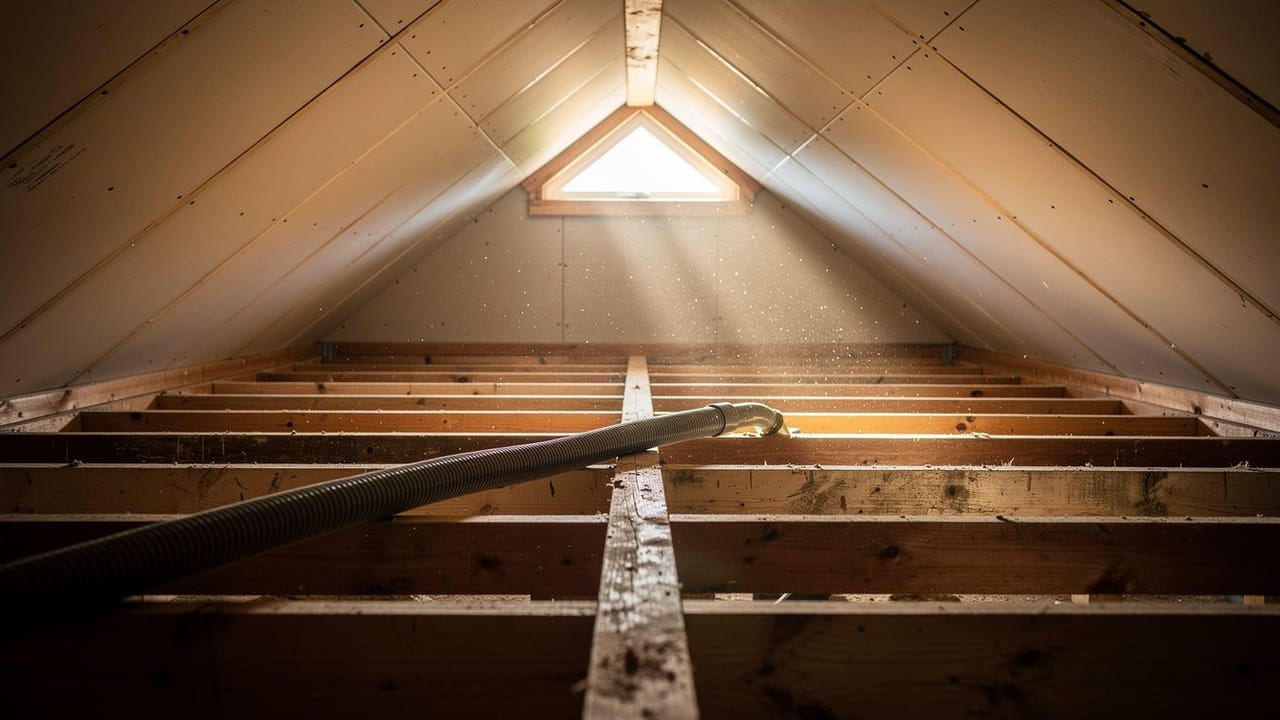
Our crews extract old insulation with an insulation vacuum. A large hose runs from the attic, through a window or the attic access, to a collection unit on a truck or trailer outside, so the material goes straight from the joists into bags or a container without being carried through the house. The ceiling below is protected at the access, and the hose route is covered.
With the attic empty, contaminated surfaces get cleaned and sanitized. Where rodents or mold were the reason, that means the ceiling drywall between the joists, the framing and the decking they reached. Then comes air sealing, which is far easier with the joist bays bare than it ever will be again. The DOE guide puts air sealing before insulating and lists the conditions under which neither should go ahead, all of which have to be dealt with first. Our post on air sealing before you add any insulation covers what gets sealed.
- Vermiculite in the attic, until it has been tested or removed
- Active knob and tube wiring
- Bath fans venting into the attic instead of outside
- A roof that is still leaking
What can stay, and how deep to go back
Insulation that is dry, clean and free of droppings, mold, smoke and vermiculite stays. Removing good insulation only to replace it costs the homeowner twice. We level it, seal what needs sealing around it and blow new insulation over it to the target depth. Partial removal is common too: the wet patch under an old leak or the corner a family of squirrels used comes out, and the rest is topped up.
When the attic is bare, there are two figures worth knowing, and they are not the same. The first is the legal minimum. Tennessee has adopted the 2018 IECC statewide for one- and two-family homes with its own amendments, per the State Fire Marshal’s list of currently adopted codes, and the Insulation Institute’s summary of the Tennessee energy code puts ceilings in climate zone 4 at R-38. We have not checked what Metro or any other city has adopted on top of that, so ask the local codes office if a permit is involved.
The second is the efficiency recommendation. Davidson County is in climate zone 4A according to the DOE Building America climate zone guide, and ENERGY STAR’s attic R-value chart recommends R60 for an uninsulated attic in that zone, or R49 where 3 to 4 inches already exists. After a full removal, the attic is uninsulated, so R60 is the recommendation and R-38 is the floor. Our post on how much attic insulation a Nashville house needs explains how those R-values translate into inches.
Sources
- CDC, MMWR RR-51(9): Hantavirus Pulmonary Syndrome, Updated Recommendations for Risk Reduction — Disinfect rodent urine, droppings and contaminated surfaces before vacuuming or sweeping; protective equipment for heavy infestations.
- U.S. EPA, Mold Remediation in Schools and Commercial Buildings, Table 1 — Water-damaged cellulose and fiberglass insulation: discard and replace.
- U.S. EPA, Mold Cleanup in Your Home — Absorbent or porous materials may have to be thrown away if they become moldy.
- U.S. EPA, Protect Your Family from Asbestos-Contaminated Vermiculite Insulation — Assume vermiculite contains asbestos, do not disturb it, use a trained professional to remove it.
- U.S. DOE Building America, Measure Guideline: Guide to Attic Air Sealing (2014) — Air seal before insulating; do not proceed with vermiculite, active knob and tube wiring, bath fans venting into the attic or a leaking roof.
- Tennessee State Fire Marshal, Currently Adopted Codes — 2018 IECC with amendments for one- and two-family dwellings, statewide.
- Insulation Institute, Tennessee Energy Code Highlights (April 2025) — Tennessee-amended code: R-38 ceilings in climate zone 4.
- U.S. DOE Building America, Guide to Determining Climate Zone by County v7.3 — Davidson County, Tennessee: climate zone 4A, mixed-humid.
- ENERGY STAR, Insulation R-values — Zone 4A attics: R60 uninsulated, R49 with 3 to 4 inches existing.