
· by Michael Blair, Nashville's Insulation
A homeowner looks into the attic a few years after it was insulated and the layer seems lower than it was on install day. The worry is that the insulation has lost its value and the money went into the ceiling for nothing.
Some of that is real. Loose fill does sink. But the rules that govern how insulation is labeled and sold were written around that fact, so the question worth asking is a different one: was enough material put in to begin with?
Does blown-in insulation settle over time?
Yes, and by different amounts depending on what it is made of. The Department of Energy’s Building America Solution Center, in its loose-fill insulation calculator, says loose-fill cellulose settles 10 to 20 percent over time from gravity and vibration, and loose-fill fiberglass 2 to 4 percent.
On a typical attic job that difference is visible. A cellulose layer blown in at one height will sit noticeably lower over time, while fiberglass will look much the same. Neither means the job failed.
What settling does not do is change how much material is up there. The pounds per square foot stay the same; the layer just packs a little tighter. That is why the federal labeling rules treat settled thickness as the number that counts.
Is the R-value on the bag before or after settling?
The R-value on a bag of loose fill is the figure after settling, not before. The Federal Trade Commission’s R-value Rule, at 16 CFR 460.5, requires loose-fill cellulose to be tested at its settled density and other loose fills on samples that fully reflect the effect of settling. So the number on the bag already allows for the layer sinking.
The same rule, at 16 CFR 460.12, requires every loose-fill bag to carry a coverage chart. For each R-value from R-13 to R-49 it lists the minimum settled thickness, the initial installed thickness, the maximum net coverage area, the bags per 1,000 square feet and the minimum weight per square foot, along with the blowing machine and settings used to get those numbers.
So a crew that blows to the chart’s initial thickness, with at least the chart’s number of bags for the area, delivers the labeled R-value after the layer settles.
What should the attic insulation certificate list?
It should list the initial installed thickness, the settled thickness, the settled R-value, the installed density, the coverage area and the number of bags. Section N1101.10.1 of the 2024 International Residential Code as adopted in Nashville requires the installer to put those on a certification, sign and date it, and post it where it can be seen on the job.
Federal law asks for nearly the same thing on paper. Under 16 CFR 460.17, an installer of loose fill must hand the customer a signed, dated receipt that lists the area covered, the depth as installed, the lowest depth it may settle to, the R-value and how many bags went in.
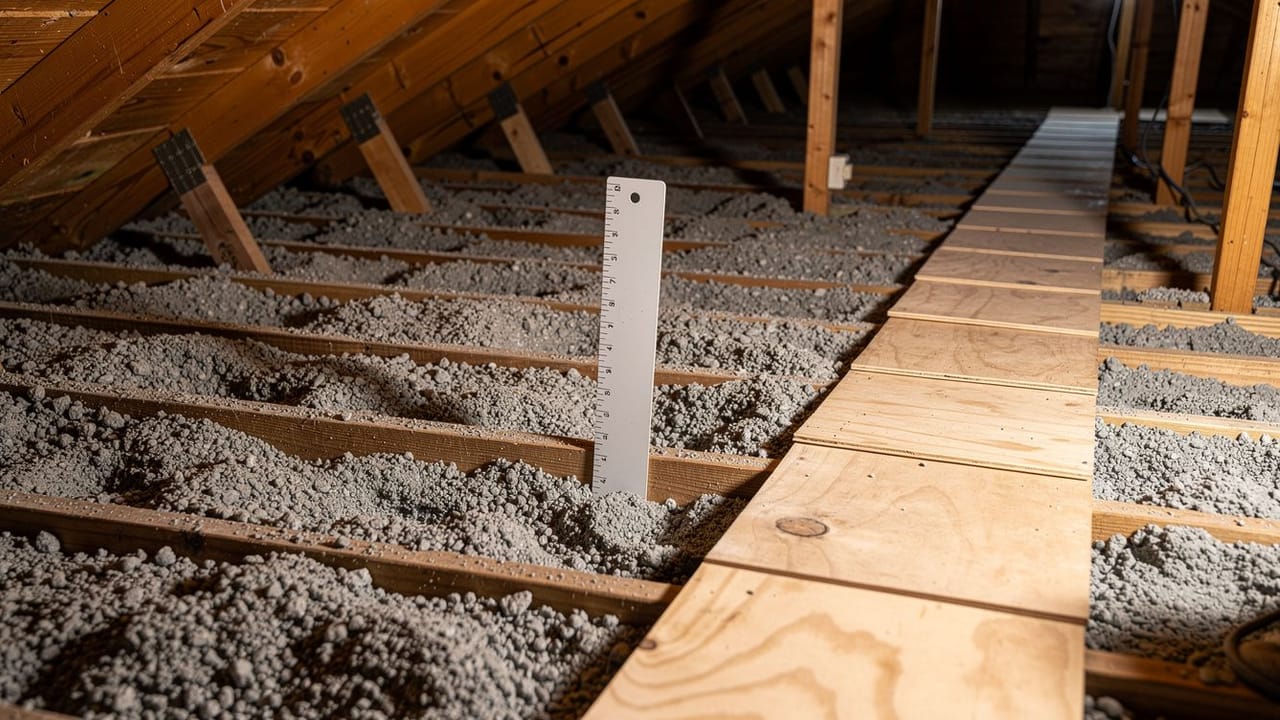
The code adds markers. N1101.10.1.1 calls for one depth marker for every 300 square feet of attic, fastened to the trusses or joists, marked with the minimum initial installed thickness in numbers at least an inch tall, each facing the attic access.
How we check the depth you paid for
We check the bag count against the chart first, because depth alone can mislead. The Solution Center’s calculator warns that when material is fluffed, installed below the maker’s minimum density, the job takes fewer bags. A fluffed layer can reach the right height on day one and still end up below the minimum settled thickness. Divide the attic area by the chart’s coverage per bag, and compare that with the bags on the certificate.
Then we read the markers from the hatch and probe the layer in several places across the attic, not just near the hatch. Our blown-in insulation jobs leave the certificate posted and the markers set, and our post on how much attic insulation a Nashville house needs covers the target. We work across the area, including attic insulation in Donelson. If you are not sure what went into your attic, send us a photo of the certificate or the hatch view.
Sources
- Building America Solution Center (U.S. DOE / PNNL), Loose-Fill Insulation calculator — Loose-fill cellulose settles 10 to 20 percent over time from gravity and vibration; loose-fill fiberglass 2 to 4 percent; fluffing (below the manufacturer’s minimum density) means fewer bags.
- Federal Trade Commission R-value Rule, 16 CFR 460.5, R-value tests (Cornell LII) — Loose-fill cellulose tested at settled density; other loose fills on samples that fully reflect settling; initial installed thickness determined under ASTM C1374.
- Federal Trade Commission R-value Rule, 16 CFR 460.12, Labels (Cornell LII) — Loose-fill coverage chart: minimum settled thickness, initial installed thickness, maximum net coverage area, bags per 1,000 square feet and minimum weight per square foot at R-13 to R-49, plus blowing machine and settings.
- Federal Trade Commission R-value Rule, 16 CFR 460.17, What installers must tell their customers (Cornell LII) — Loose-fill receipt: coverage area, initial installed thickness, minimum settled thickness, R-value and number of bags, dated and signed.
- 2024 International Residential Code, Chapter 11 Energy Efficiency, as published for Nashville by UpCodes — N1101.10.1 certification listing initial and settled thickness, settled R-value, installed density, coverage area and bags, signed, dated and posted; N1101.10.1.1 one marker per 300 square feet, 1-inch numbers, fixed to framing, facing the access (third-party code viewer).
FAQ
How Much Blown-In Insulation Settles, and Why — questions
How much does cellulose insulation settle?
The Department of Energy’s Building America Solution Center puts loose-fill cellulose settling at 10 to 20 percent over time, from gravity and vibration. Federal rules require cellulose to be tested at its settled density, so the R-value on the bag already reflects that settling when the chart’s depth and bag count are followed.
How much does blown fiberglass settle?
Much less than cellulose. The Building America Solution Center gives 2 to 4 percent over time for loose-fill fiberglass. The coverage chart on the bag still lists both an initial installed thickness and a minimum settled thickness for each R-value, and both are what the installer’s receipt has to show.
What are attic insulation depth markers?
They are rulers fastened upright to the trusses or joists, one for every 300 square feet of attic under the residential code. Each shows the minimum initial installed thickness in numbers at least an inch tall and faces the attic access, so anyone at the hatch can see whether the layer reached it.
What does an insulation receipt have to show?
For loose fill, the FTC’s R-value Rule makes the installer sign and date a receipt giving the square footage covered, the starting depth, the minimum depth after settling, the R-value and the bag count. For batts and other products it shows coverage area, thickness and R-value. The bag count is the figure most worth checking.
Does settling lower the R-value of insulation?
Not below the labeled figure, when the job was done to the chart. The FTC requires loose-fill R-values to be measured at settled density or on samples reflecting settling. A layer that was fluffed, blown light so it reached the right height with too few bags, can settle below the minimum settled thickness.