
· by Michael Blair, Nashville's Insulation
In an older house, the question we ask before any other on an insulation job is whether the attic or walls still carry knob-and-tube wiring. It is the one condition that stops the work outright, because insulation that buries those wires is exactly what the federal guidance warns against. The fix is not complicated, but it is in the right order: the wiring gets settled by an electrician, and then the attic insulation or wall insulation goes in. Here is what the guidance says, how to spot the wiring, and how the job runs when we find it.
Can insulation go over knob-and-tube wiring?
Insulation should not go over or around knob-and-tube wiring, according to the Department of Energy’s guidance. The Building America Solution Center’s guide to blown insulation in existing exterior walls, run by Pacific Northwest National Laboratory, says that where a house has knob-and-tube wiring, the scope of National Electrical Code Article 394 does not allow insulation to be applied to the wiring or to surround it.
ENERGY STAR reaches the same place from the attic side. Its attic insulation project tells homeowners to consult or hire a professional before starting if the attic has knob-and-tube wiring, which it dates to before 1930 and describes as a possible fire hazard when it is in contact with insulation.
Neither page says knob-and-tube must be torn out before any house can be insulated, and we won’t say it either. What both say is that insulation and live knob-and-tube wiring should not end up in contact, and that a professional makes the call before the work starts.
How can you tell if an attic or wall has knob-and-tube wiring?
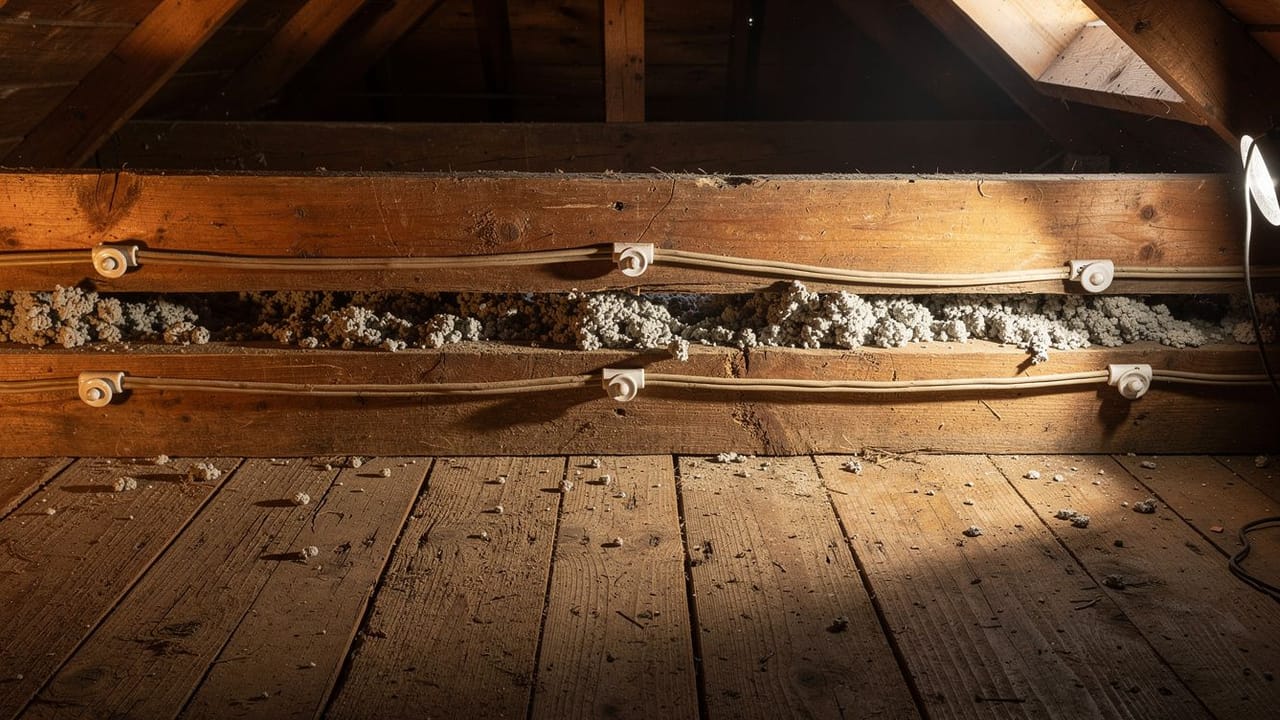
Knob-and-tube wiring is easy to recognize in an open attic: single insulated wires run separately, a few inches apart, held off the framing by white porcelain knobs, and pass through joists and studs inside porcelain tubes. Modern cable bundles its wires together in one sheathed jacket; knob-and-tube does not. ENERGY STAR ties it to houses built before about 1930, so in Nashville it is worth looking for in the older close-in neighborhoods and in any farmhouse of that age.
In a wall you usually cannot see it, and the attic or basement is where it shows. ENERGY STAR’s list of reasons to stop and call a professional before insulating an attic includes two more worth checking on the same trip: kitchen, bath or dryer vents that blow moist air into the attic instead of outdoors, and damp or wet insulation, which points to a roof leak. Seeing old wiring does not tell you whether it is still connected, and that is the electrician’s part.
What has to happen before an old house with knob-and-tube is insulated?
Before an old house with knob-and-tube is insulated, a licensed electrician has to find out whether that wiring is still in service and decide what happens to it. That is electrical work, not ours, and the electrical rules in Davidson County are Metro’s: the Metro Codes adopted codes list, updated July 28, 2025, includes the 2023 National Electrical Code among the codes adopted with local amendments. Metro Codes is at 800 President Ronald Reagan Way and answers at 615-862-6500 for anything about permits or what applies to a particular house.
For walls there is a second check. The same Building America guide notes that lead-safe work rules apply to homes built before 1980 when walls are disturbed, which covers every house old enough to have knob-and-tube. Our post on insulating the empty walls of an older house goes through the drill-and-fill method and the checks that come with it.
What happens to an insulation job when we find knob-and-tube?
When we find knob-and-tube on an insulation job, that part of the house waits until an electrician has settled the wiring, and we tell you so in writing rather than working around it. We don’t lay batts over it, blow loose fill on top of it, or dense-pack a wall bay it runs through.
Once the electrician has finished, the job goes ahead in the usual order: air sealing first, then blown-in insulation or batts to the depth the attic needs. If old insulation in the attic has to come out first because of rodents, water or age, our post on when old attic insulation has to come out covers that decision. If you are in Nashville or nearby with an older house and are not sure what is in the attic, ask us to take a look before you buy any insulation.
Sources
- U.S. Department of Energy, Building America Solution Center (PNNL), Blown Insulation in Cavities of Existing Exterior Walls — Where a home has knob-and-tube wiring, the National Electrical Code Article 394 scope rules out insulation applied to or surrounding the wiring; lead-safe rules for homes built before 1980 when walls are disturbed
- ENERGY STAR, Attic Insulation Project — Consult or hire a professional first if the attic has knob-and-tube wiring (pre-1930), a possible fire hazard in contact with insulation; also vents exhausting into the attic and wet or damp insulation
- Metro Nashville Codes & Building Safety, Adopted Codes List (updated July 28, 2025) — Codes adopted with local amendments include the 2023 National Electrical Code; office at 800 President Ronald Reagan Way, 615-862-6500
FAQ
Insulation Over Knob-and-Tube Wiring: What First — questions
Is knob and tube wiring safe with insulation?
Not in contact with it, by the federal guidance. ENERGY STAR describes knob-and-tube as a possible fire hazard when it touches insulation, and the Department of Energy’s Building America guide says the National Electrical Code’s Article 394 scope rules out insulation laid on it or packed around it. A licensed electrician should decide what happens to the wiring first.
Does knob and tube wiring have to be replaced before insulating?
The guidance we rely on stops short of saying it must always be replaced. It says insulation must not be laid on the wiring or packed around it, and that a professional should be consulted first. Whether live wiring is replaced, taken out of service or handled another way is a licensed electrician’s decision, made before any insulation goes in.
Can you blow insulation into walls with knob and tube wiring?
Not while the wiring runs through those wall bays. The Department of Energy’s guide to blown insulation in existing walls says the National Electrical Code’s Article 394 scope rules out insulation laid on knob-and-tube wiring or packed around it. An electrician settles the wiring first, and lead-safe rules apply to walls in homes built before 1980.
What does the electrical code say about insulation on knob and tube wiring?
As the Department of Energy’s Building America guide reports it, National Electrical Code Article 394, which covers knob-and-tube wiring, rules out insulation laid on the wiring or packed around it. In Davidson County, Metro Codes lists the 2023 National Electrical Code among its adopted codes, so ask Metro or a licensed electrician what applies to your house.
How do I know if my house has knob and tube wiring?
Look in the attic or basement for single wires running a few inches apart on white porcelain knobs and passing through framing in porcelain tubes, rather than wires bundled in one sheathed cable. ENERGY STAR dates the wiring to before about 1930. Seeing it does not tell you whether it is still live; an electrician can.