
· by Michael Blair, Nashville's Insulation
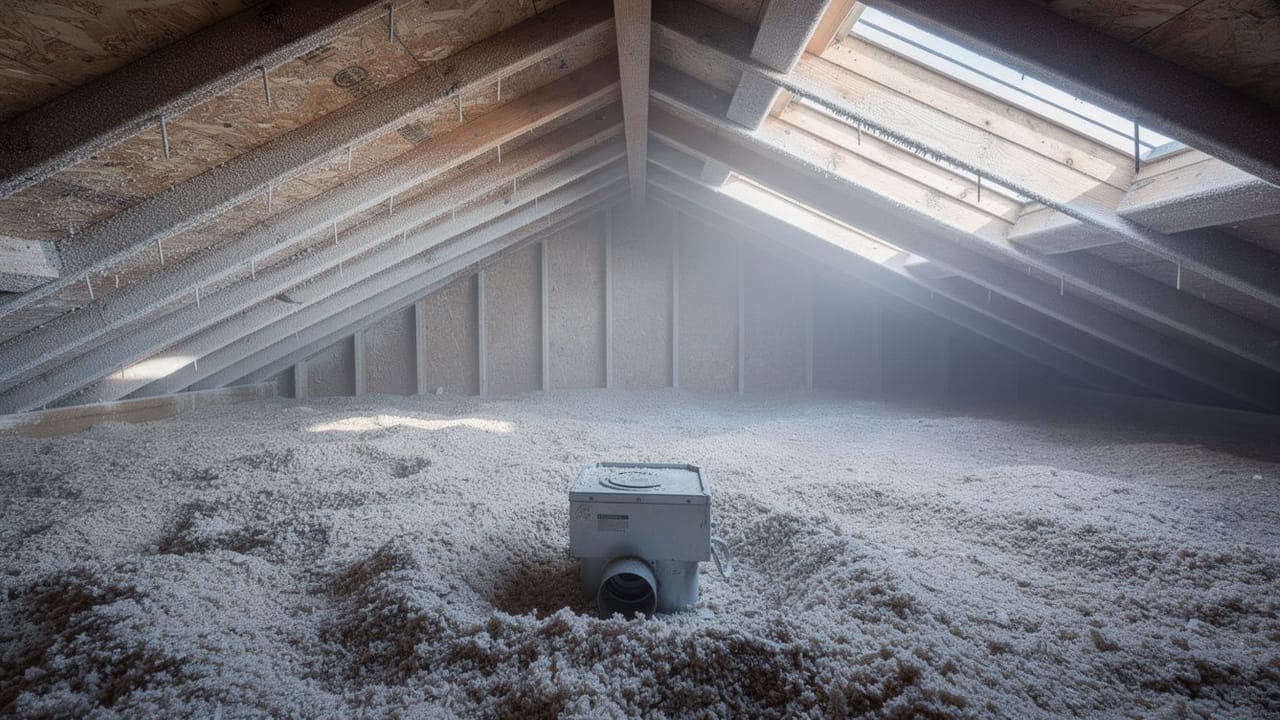
Go into the attic after a run of cold nights and you may find the underside of the roof deck white with frost, or a sprinkle of drops on the insulation where it has melted off the nail tips. Middle Tennessee winters are mild by northern standards, but a hard January cold snap is enough to do it, and the water it leaves behind is real.
It is easy to assume the roof is leaking. Usually it is not. The water came from inside the house, and the cure is in the ceiling below the attic, which is our side of the job.
What causes frost in an attic in winter?
Frost in an attic in winter is moisture from the house that has leaked up into the attic and frozen on the coldest surfaces. The Department of Energy’s cold-weather guide to attic and roof condensation, published through the Building America Solution Center, describes three conditions working together: roof framing and sheathing cold enough to fall below the dew point, warm humid indoor air reaching them through holes in the ceiling, and too little drying.
Warm air rises on its own, so the leaks run even on a still night. The guide says wind, unbalanced mechanical ventilation and leaky ducts in the attic push more air through. In a Middle Tennessee house with the air handler and ductwork in the attic, as so many have, that last one deserves a look; our post on sealing attic ductwork covers it.
The frost itself is not what does the damage, the guide says. The harm starts on the thaw, when the sheathing and framing soak up the meltwater and stay wet until the attic dries them out. Repeated over winters, that means mold, rot, swollen or delaminated OSB, rusted nails and weakened framing.
Where does the moist air get into the attic?
Moist air gets into the attic through every hole in the ceiling and through any fan that blows into the attic instead of outdoors. The Building America guide names the ceiling penetrations first: recessed lights, wiring, vent pipes and ducts. Many of them sit under the insulation where you cannot see them, and the attic hatch or pull-down stair is another, as our post on sealing the attic stair explains.
Exhaust fans are the other source, and a direct one. The 2018 International Residential Code as adopted in Tennessee, Section M1501.1, says exhaust air shall not be discharged into an attic, soffit, ridge vent or crawl space, and Section M1505.2 says bathroom exhaust goes directly outdoors. A bath fan with its duct lying loose in the insulation, or aimed at a soffit vent, pumps shower steam straight onto the roof deck.
ENERGY STAR’s attic insulation project puts kitchen, bath and dryer exhausts that end inside the attic on its short list of problems to fix before any insulation work starts.
Is it frost, a roof leak or something else?
Frost and condensation show up after cold nights and spread across the underside of the deck, while a roof leak shows up after rain and tracks back to one spot. Water stains on the ceiling or drips off the nail tips during a thaw, with dry weather outside, point to condensation. A stain that grows only when it rains points to the roof, and that is a roofer’s repair.
ENERGY STAR’s list helps sort the rest. It treats wet or damp insulation as a sign of a leaky roof and moldy or rotted rafters or joists as a sign of a moisture problem, and both are on its list of things to get professional help with before adding insulation. Little or no attic ventilation is on the same list.
When we look at an attic like this, we check where each fan ends, find the ceiling openings under the insulation, and note whether the soffit and roof vents are open. That usually tells us whether the water is coming from the house below or the roof above.
How do you stop condensation in the attic?
You stop condensation in the attic by keeping house air and moisture out of it, in this order. First, every bath, kitchen and dryer exhaust gets ducted all the way outdoors. Second, the ceiling plane gets air sealed; the Building America guide notes that a thin layer of spray foam, about 1 to 2 inches, over the ceiling with blown insulation on top is one way to do it, and it suggests a blower door test to confirm the air barrier.
Third, indoor humidity: the guide recommends roughly 30 to 50 percent relative humidity in the heating season. Fourth, ventilation. It describes code as typically asking for a 1-to-150 ratio of net free vent area to attic floor area, split evenly between intake and exhaust with exhaust never more than intake, and 2 inches kept clear between the deck and the insulation.
Insulation comes last. ENERGY STAR passes on EPA’s advice to seal the attic’s air leaks first and insulate second, and the Building America guide notes that insulation warms the surfaces where condensation would form. Adding attic insulation over open leaks leaves the air path in place. If you are in Donelson or anywhere around Nashville and found frost up there this week, ask us to look at the attic.
Sources
- U.S. Department of Energy, Building America Solution Center (PNNL), Condensation Control in Attics and Roofs (Cold Weather) — Cold surfaces, air leakage and insufficient drying; buoyancy, wind, unbalanced ventilation and leaky attic ducts; damage when frost melts; ceiling penetrations; spray foam layer and blower door test; 30 to 50 percent RH; 1/150 vent area split evenly, 2-inch baffle clearance
- International Residential Code 2018, Sections M1501.1 and M1505.2 (Tennessee state-adopted edition, UpCodes) — Exhaust air not discharged into an attic, soffit, ridge vent or crawl space; bathroom exhaust directly outdoors
- ENERGY STAR, Attic Insulation Project — EPA recommends air sealing before insulating; vents exhausting into the attic, little or no ventilation, wet insulation and moldy framing as problems to fix first
FAQ
Frost or Condensation in the Attic in Winter — questions
Why do I have frost in my attic?
Because warm, humid air from the rooms below is leaking into the attic and freezing on the roof deck, which is colder than its dew point. The Department of Energy’s Building America guide names ceiling penetrations, leaky attic ducts, unbalanced ventilation and fans venting into the attic as the usual paths.
Is frost in the attic harmful?
The frost itself does little, according to the Department of Energy’s Building America guide. The harm starts on the thaw, when the roof deck and framing soak up the meltwater and stay damp for a while. Over repeated winters that can mean mold, rot, swollen or delaminated OSB, rusted fasteners and weakened framing, so the source is worth fixing.
Can a bathroom exhaust fan vent into the attic?
No. The 2018 International Residential Code adopted in Tennessee says exhaust air shall not be discharged into an attic, soffit, ridge vent or crawl space, and bathroom exhaust must go directly outdoors. A bath fan dumping steam into the attic is one of the most direct causes of winter condensation on the roof deck.
Does adding insulation stop attic condensation?
Not by itself. ENERGY STAR passes on EPA’s advice to seal the attic’s air leaks before insulating, because insulation does not stop air carrying moisture through the ceiling. Once the leaks are sealed and the fans vent outdoors, more insulation helps by keeping warm air below and the ceiling surfaces warmer.
What indoor humidity helps prevent attic condensation in winter?
The Department of Energy’s Building America guide recommends keeping relative humidity at roughly 30 to 50 percent during the heating season. Higher indoor humidity raises the dew point of the air that leaks into the attic, so more of it condenses or freezes on the roof deck.