
· by Michael Blair, Nashville's Insulation
Walk through an East Nashville four-square or a Sylvan Park cottage on a January evening and stand next to an exterior wall; the cold coming off it is the wall cavity, empty since the house was built. Attic insulation and crawl space work are the first jobs on an old house because they are easy to get at, and they do the most. The walls come after, and the question is whether they can be insulated without tearing off the plaster or the siding. In most cases they can, by drilling holes and blowing insulation into the cavities, and the job goes well or badly depending on what is inside those walls and who does it.
What is in the wall now
Before the 1960s, most wood-framed houses here were built with empty stud bays, sometimes with a layer of building paper or nothing at all behind the siding. Some have been partially insulated since, with a loose fill blown in the 1970s that has settled to the bottom third of the cavity, or with batts in the walls that were opened during a remodel. Some have knob-and-tube wiring in the bays, which cannot be buried in insulation until it is replaced.
The way to find out is to open the wall: pull an outlet cover and probe beside the box, or drill a small inspection hole in a closet, or have the contractor use an infrared camera on a cold morning, which shows every empty bay as a cold stripe. A blower-door test at the same time shows how much air the walls are leaking, which is the other half of what insulating them fixes.
Dense-pack cellulose
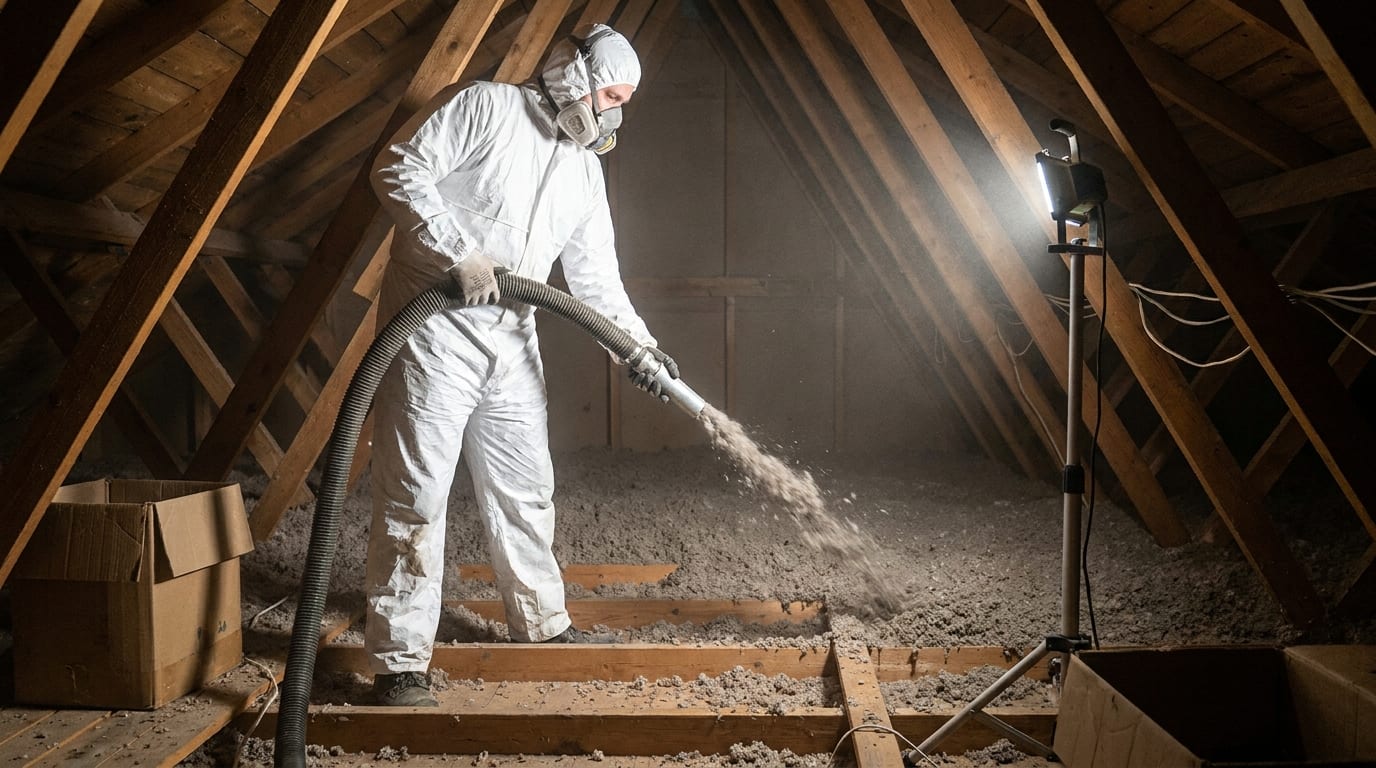
The standard method for filling an existing wall is dense-pack cellulose: recycled paper fiber treated with borates, blown into each stud bay through a hole at high density so it packs tight, does not settle, and blocks air movement through the cavity. The holes are drilled from outside, under a course of siding that is lifted and replaced, or from inside through the plaster, then plugged and patched. Each bay gets checked to make sure it is full to the top and around any blocking.
Done right, it turns an empty wall into an insulated one that also leaks far less air. Done badly, it leaves voids at the top of bays and around fire blocking, and the wall is half insulated. The contractor should be able to show the density they pack to and should check bays with a thermal camera afterward.
- Dense-pack cellulose: the usual choice, fills irregular cavities, moderate cost
- Injection foam: fills well, more expensive, needs care with moisture
- Blown fiberglass: settles less than old loose fill, less air sealing than cellulose
- Any method: knob-and-tube must be gone first
Moisture, and why it matters in Middle Tennessee
An empty wall dries easily; air moves through it and carries moisture out. A filled wall dries more slowly, so anything that was getting wet before, a leak at a window, a missing drip cap, brick veneer with no drainage gap, becomes a problem once the cavity holds insulation against it. Cellulose tolerates some moisture and lets a wall dry outward; closed-cell foam does not, and a foam-filled wall with a leak rots quietly. Whichever material is used, the exterior should be checked for the places water gets in before the walls are filled.
Our humid summers push moisture inward through the wall as well, and an old house with no vapor retarder and a wall now full of insulation relies on the interior finish and the air conditioning to manage that. Cellulose handles it well. What to avoid is a vinyl wallpaper or an impermeable finish on the inside of a filled wall on the north side, which traps moisture where it condenses.
What to expect from the job and the result
Exterior work from outside is a few days for an ordinary house, with the siding put back so the holes do not show; on brick veneer, the holes go through mortar joints and are repointed, or the work is done from inside. Interior work through plaster leaves a patch per bay that needs finishing and painting. The house is noticeably quieter afterward, drafts along exterior walls stop, and the rooms on the west side are less hot in the afternoon.
The wall will not reach the R-value of a new house; a four-inch cavity filled with cellulose is what it is. But the change from empty to filled is the largest single improvement, and combined with an air-sealed attic and a dry crawl space it is what turns an old Nashville house from drafty to comfortable. Do the attic and the crawl space first, and the walls when the budget allows.