
· by Michael Blair, Nashville's Insulation
Fiberglass batts are the most common insulation in the walls and attics around here, and the material itself is rarely the problem. The trouble is how it went in. A batt that stops an inch short of the top plate, gets stuffed behind a cable, or is squeezed into a bay narrower than it was cut for still looks like insulation from across the room, but it is not doing the whole job. Here is what the installation standard asks of a batt, what a poor job looks like, and what we can correct in place as part of attic insulation and wall work in a Middle Tennessee house.
What counts as Grade 1 insulation installation?
Grade 1 is the best of the three installation grades RESNET, the Residential Energy Services Network, uses when a house is energy rated, and it means the insulation fills the cavity with almost no gaps or squeezing. The Department of Energy’s Building America Solution Center guide to Grade 1 installation, run by the Pacific Northwest National Laboratory, describes Grade 1 batts as filling each wall cavity evenly, edge to edge and from the bottom plate to the top, with no real gaps or voids where wires, pipes and boxes pass through, because the batts are cut to fit around them.
Owens Corning’s guide to Grade 1 installation with fiberglass batts, written with Advanced Energy, quotes the RESNET standard: the batt is split, installed or fitted tightly around wiring and other services, and compression or incomplete fill amounting to 2 percent or less is acceptable when the empty spaces are less than 30 percent of the insulation’s thickness. The guide notes that the installation grade is one of the factors in a home’s energy rating.
Faced batts can still reach Grade 1. The same guide says side-stapled tabs qualify if they are stapled neatly, without buckling, and the batt is compressed only at the edge of each cavity to the depth of the tab.
What does a poorly installed fiberglass batt look like?
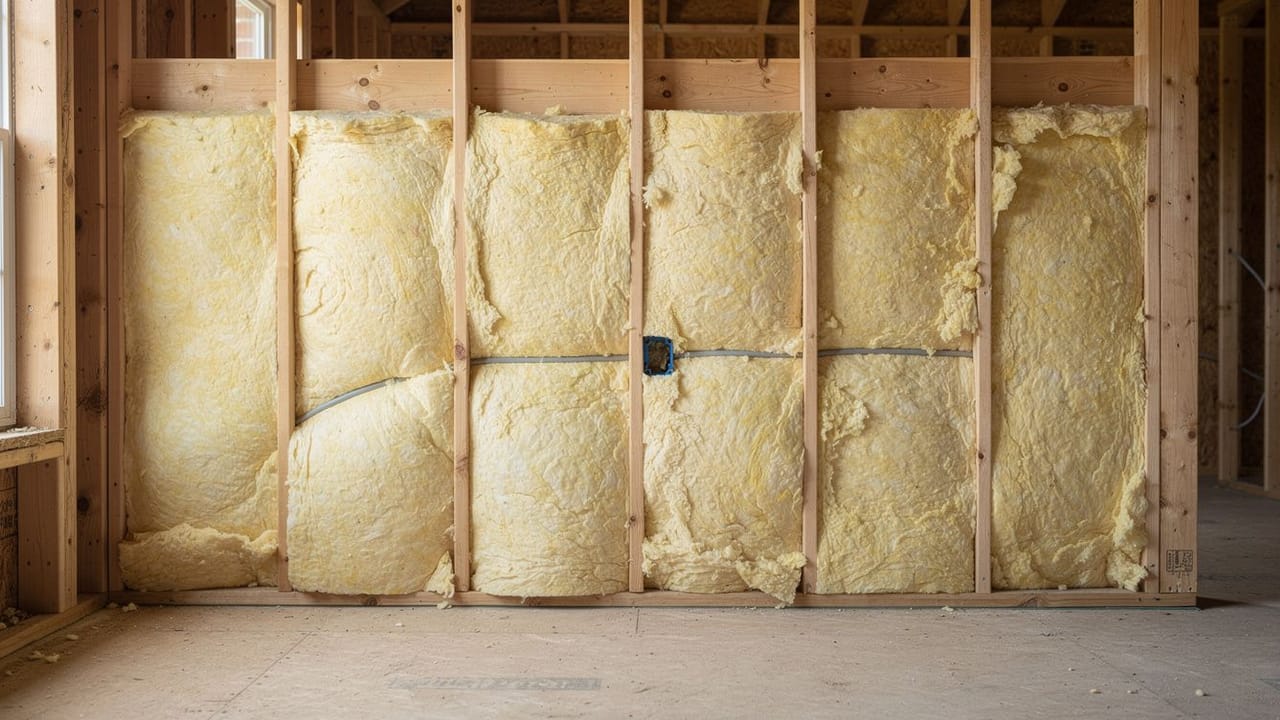
It leaves part of the cavity empty or squeezes the batt out of shape. In an open wall, that means a strip of bare framing above or below the batt, a gap down one stud, a batt pushed flat behind a cable or pipe so the space in front of it is empty, a batt folded into a bay too narrow for it, or a faced batt whose paper tabs buckle where they were stapled. The Building America guide adds a simple test: if the exterior sheathing shows through gaps at inspection, the work is not Grade 1.
Those gaps matter more than their size suggests. The same guide says gaps, voids and compressions that pull insulation away from the surface it is meant to insulate cause cold spots in walls, ceilings and floors, and those cold spots can encourage condensation inside the cavity. It also asks that insulation be enclosed on all six sides of the cavity, which is why a batt that has slumped away from the drywall is a defect even when it still fills the bay.
In an attic, the signs are batts that do not meet end to end, batts lifted off the ceiling by a duct or wire, and low spots along the eaves.
How tight should a fiberglass batt fit in the cavity?
Snug from stud to stud and plate to plate, in contact with the drywall along its whole face, and not squeezed anywhere except at the stapled tab of a faced batt. A batt should be the width the bay calls for; one forced into a narrower bay bunches, and one cut short leaves a gap that air will find.
Around a wire, the batt is split rather than pressed behind it, so the cable runs through the insulation and the full thickness stays on both sides. Around a pipe or an outlet box, the batt is cut to fit the obstruction. Owens Corning’s checklist puts it the same way for every surface it covers: no misalignments or compressions, full contact with all sides of the cavity, and insulation cut or split around blocking, plumbing, ducts and wiring.
Checking your own, and what can be corrected
An attic is the easy place to look. ENERGY STAR’s DIY checks and inspections say that insulation level with or below the attic floor joists probably means you need more, and that it should be evenly spread with no low spots; there is sometimes enough in the middle of the attic and little along the eaves. The same page warns to step only on joists or truss chords, never on the drywall or the insulation, to avoid falling through the ceiling.
Walls are closed, but an outlet gives a look. ENERGY STAR describes turning off power to an outlet on an outside wall, confirming it is dead with a voltage tester, removing the cover and shining a flashlight into the gap beside the box to see whether there is insulation and roughly how thick it is.
In an open attic we can usually correct batts in place: refit the ones that pulled apart, close the gaps at the ends and edges, lift batts back down onto the ceiling, and lay blown-in insulation over the top where depth is short. Any air leaks in the ceiling get closed first, which our post on air sealing before insulation explains. A closed wall is a bigger decision, covered in our post on insulating the empty walls of an older house. For a house in Berry Hill, Nashville or nearby, tell us what you found and send a photo of the attic if you can.
Sources
- U.S. Department of Energy, Building America Solution Center (PNNL), Insulation Installation Achieves RESNET Grade 1 — Grade 1 described: cavities filled side to side and top to bottom, batts cut to fit around wiring and piping, insulation enclosed on all six sides; gaps and compression cause cold spots and may encourage condensation; visible sheathing fails Grade 1.
- Owens Corning and Advanced Energy, Achieving Grade 1 Insulation Installation with Fiberglas Batts — Quotes the RESNET standard: batts split or fitted around services; compression or incomplete fill of 2 percent or less with voids under 30 percent of thickness; faced batt tab rules; grade as a factor in the home energy rating.
- ENERGY STAR, DIY Checks and Inspections — Attic insulation level with or below the joists likely needs more; even coverage with no low spots; step only on joists; outlet check for wall insulation with power off.
FAQ
Fiberglass Batts Installed Wrong, and How to Tell — questions
Why does fiberglass batt insulation leave cold spots?
Because a batt only insulates where it fills the cavity and touches the surface it covers. The Department of Energy’s Building America guide says gaps, voids and compressions that pull insulation away from that surface cause cold spots in walls, ceilings and floors, and can encourage condensation inside the cavity.
Should fiberglass batts be split around wires and pipes?
Around wires, yes. RESNET’s Grade 1 standard, as quoted by Owens Corning, calls for batts split, installed or fitted tightly around wiring and other services, so the cable runs through the batt instead of pinning it back. Around pipes and outlet boxes, the batt is cut to fit the obstruction so the cavity stays full.
How can you tell fiberglass insulation was installed badly?
Look for bare framing above or below a batt, gaps along a stud, batts pressed flat behind cables, folded batts in narrow bays and buckled paper tabs. In an attic, look for batts that do not meet end to end and low spots at the eaves. Sheathing visible through a gap fails Grade 1.
Can gaps in fiberglass insulation be fixed without pulling it all out?
Often, in an attic. We refit batts that pulled apart, close gaps at the ends and edges, set lifted batts back down onto the ceiling, and add blown insulation over the top where depth is short, after sealing air leaks. In a closed wall the batts cannot be reached without opening it.
Does squeezing a fiberglass batt into a small space lower its performance?
The installation standard treats it as a defect. RESNET’s Grade 1, as Owens Corning quotes it, allows compression or incomplete fill of 2 percent or less, and the Building America guide ties compression to cold spots. A batt should be the width and thickness its cavity calls for, not forced into one.