
· by Michael Blair, Nashville's Insulation
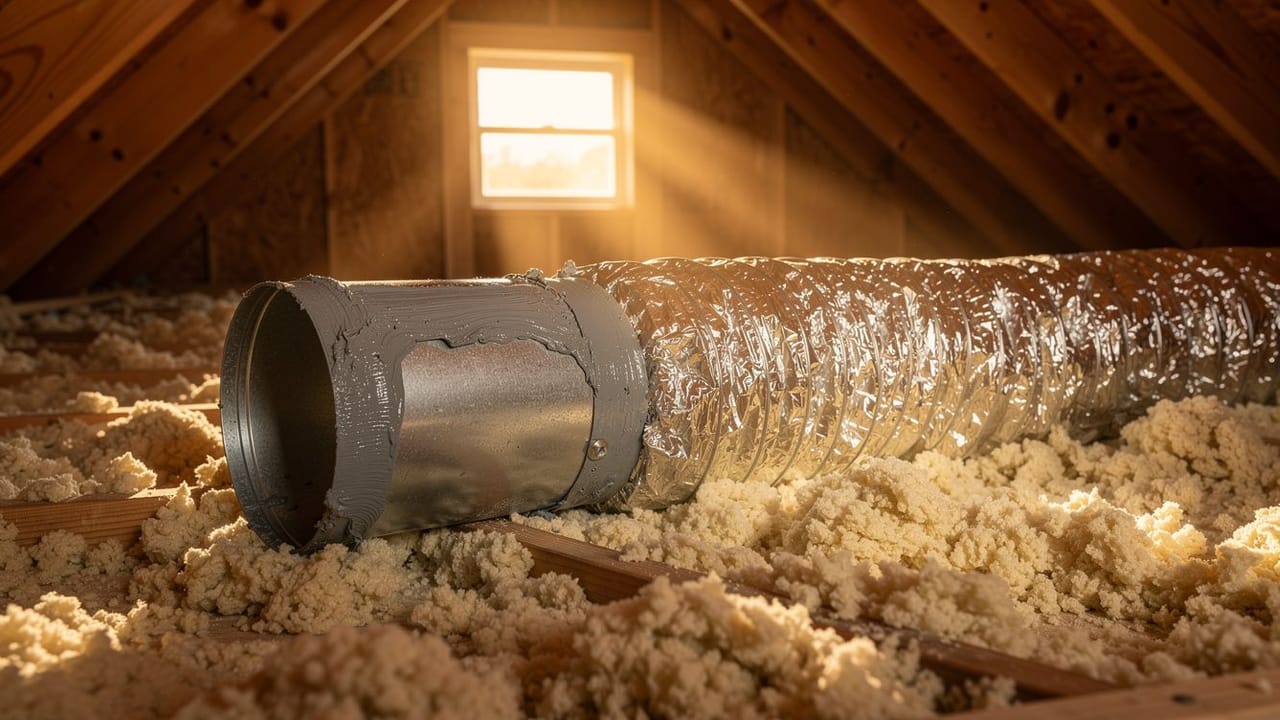
On a slab house, and on plenty of houses with a crawl space too, the supply ducts run through the attic. In a Nashville August that attic is the hottest and most humid space on the property, and cooled air has to cross it before it reaches a single room. Every open seam lets some of that air out into the attic, and every bare or poorly wrapped section warms what is left. The fix is not glamorous: seal the seams with the right material, then insulate the duct so it stays dry. It sits alongside the rest of our air sealing work, and when our crews are in an attic for insulation, the ducts are part of what we look at.
What leaky attic ducts look like from the house
The complaint is rarely the ducts themselves. It is the bedroom at the far end of the hall that never cools, the upstairs that runs several degrees warmer than the thermostat, or a system that runs long afternoons and still loses ground. Supply air that leaks into the attic is air you paid to cool that never reaches a register. A leak on the return side does the reverse and pulls hot, damp attic air into the system to be cooled again.
In the attic the clues are easier to read. Look where the trunk line leaves the air handler, at every joint between straight sections, at the elbows, and where each branch connects to the trunk or to a boot in the ceiling. Cloth duct tape that has dried, curled or fallen off is the most common thing we find. Flex duct that has slipped off a collar, or been pulled tight and crushed by a joist, is close behind. Dark streaks of dust at a seam usually mean air has been moving through it for years.
In summer, check the outside of the ducts too. Beads of water, wet insulation under a run, or a stain on the ceiling drywall below a duct all point to condensation, which is the second half of the problem.
Mastic and metal tape, not the gray cloth roll
The Department of Energy’s Building America Solution Center is plain about this in its guide to sealed and insulated metal ducts: seal every seam and joint with mastic, bridge seams wider than an eighth of an inch with fiberglass mesh tape and mastic over it, and do not use regular cloth-backed duct tape, because it can dry out and fail quickly. The adhesive on the familiar gray roll gives up in a hot attic, and the seam opens again under the insulation where nobody sees it.
Mastic is a thick paste brushed onto the joint. It stays flexible, it fills irregular gaps, and once it cures it does not let go. The DOE’s Building Science Education Solution Center page on sealed metal ducts allows either duct mastic or metal tape, as long as the product meets UL-181, UL-181A or UL-181B. Those numbers are printed on the label, and they are worth reading before anything goes on the ducts in your attic.
Sealing comes before insulation for the same reason air sealing comes before insulating an attic floor, which our post on air sealing before you add any insulation covers. Once a seam is wrapped, it is out of sight and out of reach.
- The plenum where the trunk leaves the air handler
- Every joint between straight sections of the trunk
- Elbows, takeoffs and branch connections
- Flex duct collars, where the inner liner meets the fitting
- The boots, and the gap between each boot and the ceiling drywall
Why the insulation has to be continuous
Sealing keeps the air inside the duct. Insulation keeps the heat of the attic out of it, and in Middle Tennessee it also keeps the duct dry. Air conditioning moving through a metal duct makes the metal colder than the dew point of humid attic air, and water condenses on any bare spot. The Building America guide warns that in humid climates duct sweating can become a significant problem. Water drips onto the attic insulation, soaks into it and can reach the ceiling below. Our post on insulation, vapor and Middle Tennessee humidity goes further into why moisture behaves this way here.
So the wrap has to be complete and it has to carry a vapor barrier on the outside. The Building America guide calls for blanket insulation covered with a foil or plastic vapor barrier and recommends at least R-8 on supply ducts and R-6 on returns. The DOE education page adds that the insulation has to be fully aligned and in contact with the duct walls. A wrap that is torn, gaps at the joints, or hangs loose leaves cold metal touching humid air, and that is where the water forms.
Those R-values are the Building America recommendation, not a statement of what the permit office in your county requires today. That is a separate question, and the next section deals with it.
Codes, the bonus room, and what to ask
Metro Nashville has adopted the 2024 International Residential Code and the 2024 International Energy Conservation Code with local amendments, according to Metro Codes’ adopted codes list, and its announcement of the 2024 codes gives July 16, 2025 as the effective date for plans and applications submitted after it. Outside Davidson County, the State Fire Marshal’s list of currently adopted codes sets the 2018 IECC with amendments as the baseline for one- and two-family homes, unless a city or county has adopted something newer. If your duct work is part of a permitted project, such as a new system, an addition or a remodel, ask which edition your permit office applies and what it expects for duct insulation and testing. On our Nashville page we cover the Davidson County side of the work.
Ducts are often why one room is worse than the rest. The room over the garage tends to sit at the end of the longest run through the hottest part of the attic, and our post on the bonus room over the garage covers that room as a whole. Sealing and insulating the run that feeds it is one piece of that, not all of it.
Before anyone works on your attic ducts, ask what they will seal the seams with and whether it is listed to UL-181. Ask whether every joint will be sealed, including the boots at the ceiling, or only the ones that are easy to reach. Ask how the insulation will be fastened and how the vapor barrier will be closed at the seams. And if the attic floor is due for insulation too, ask that the ducts be done first, while they are still in plain view. If you would like us to look at yours, request an estimate and tell us which rooms are hard to cool.
Sources
- U.S. DOE Building America Solution Center (PNNL), Sealed and Insulated Metal Ducts — Seal seams with mastic, mesh tape over gaps wider than 1/8 inch, no cloth duct tape; R-8 supply and R-6 return recommended with a foil or plastic vapor barrier; duct sweating in humid climates.
- U.S. DOE Building Science Education Solution Center, HVAC: Sealed and Insulated Metal Ducts — Duct mastic or metal tape meeting UL-181, 181A or 181B; insulation aligned and in contact with the duct walls.
- Metro Nashville Codes, Adopted Codes List — 2024 IRC and 2024 IECC adopted with local amendments.
- Metro Nashville Codes, Metro Adopts 2024 Building Codes — Effective July 16, 2025 for plans and applications submitted after that date.
- Tennessee State Fire Marshal, Currently Adopted Codes — 2018 IECC with amendments for one- and two-family dwellings, statewide.